Disaster Prevention Monitoring for Railways and Critical Infrastructure
Published
PT Luwes Inovasi Mandiri
Contributor: YP
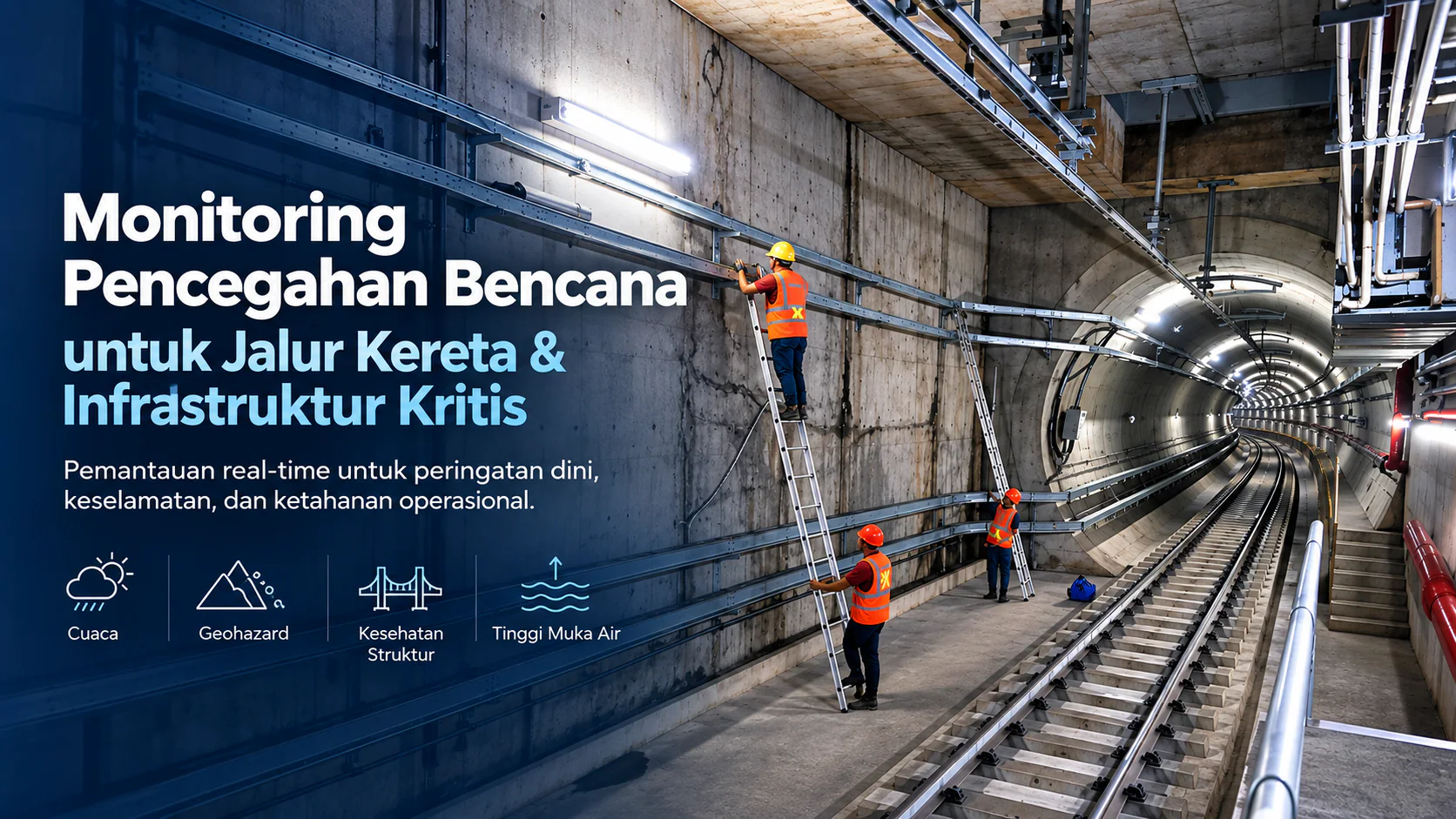
Real-time monitoring helps infrastructure operators detect changing conditions earlier, reduce dependence on manual inspections, and strengthen preparedness for risks that could affect safety and operations.
Depok - Railway lines, tunnels, bridges, elevated structures, and transportation facilities operate almost continuously. Behind these operations, structural and environmental conditions can change due to operational loads, vibration, rainfall, water-level fluctuations, soil pressure, and surrounding geotechnical conditions.
Some changes occur gradually and may not be visible through visual inspection alone. The challenge becomes even greater when infrastructure is located in densely populated areas, crosses rivers, runs underground, or is exposed to flooding and ground movement.
For this reason, risk mitigation for critical infrastructure should not rely only on inspections after problems occur. Continuous monitoring can provide an important additional layer of information to help identify abnormal conditions at an earlier stage.
From Periodic Inspection to Real-Time Monitoring
Modern monitoring systems use different types of sensors to continuously observe changes in structural and environmental conditions.
For railway structures and tunnels, for example, monitoring systems can be designed using accelerometers, tiltmeters, strain gauges, earth pressure sensors, and displacement sensors to detect changes in structural behavior.
For locations exposed to hydrometeorological risks, the system can also be expanded with Automatic Water Level Recorders (AWLR), rainfall sensors, Automatic Weather Stations (AWS), and weather intelligence.
Data from field instruments is collected by data loggers and transmitted through communication networks to a server. The information can then be presented through a monitoring dashboard, allowing multiple monitoring points to be observed from a centralized interface.
This approach enables infrastructure operators to review not only individual sensor readings, but also historical trends, changing conditions, alarms, and long-term data patterns.
Detecting Changes Before They Become Operational Problems
The value of a monitoring system is not determined simply by the number of sensors installed. More importantly, the system must convert field data into information that can support technical evaluation and operational decisions.
When a monitored parameter exceeds a predefined threshold, for example, the system can provide an indication that further inspection may be required.
An unusual increase in vibration may trigger an evaluation of structural conditions or possible sources of vibration. Changes in soil pressure around a tunnel can be compared with historical measurements. Similarly, rising water levels combined with heavy rainfall data may provide useful information for increasing preparedness in areas exposed to flooding.
This approach supports a transition from purely reactive maintenance toward condition-based monitoring and preventive maintenance.
However, an alarm does not automatically mean that a structure is unsafe. Monitoring data should still be evaluated together with field conditions, structural characteristics, engineering thresholds, and the operational procedures established by the asset owner.
Infrastructure Monitoring Experience in MRT Jakarta
PT Luwes Inovasi Mandiri has experience in the development and integration of monitoring systems for transportation infrastructure, including MRT Jakarta Tunnel Monitoring.
In this implementation, sensors installed along tunnel structure segments were integrated with data loggers and servers so that monitoring data could be accessed online. The system included instruments such as accelerometers, tiltmeters, strain gauges, and earth pressure sensors at different monitoring locations.
The data logger performs several important functions, including reading, processing, storing, and transmitting sensor measurements. The communication infrastructure also uses networks including fiber-optic connections to transmit field data to the monitoring server.
The implementation illustrates how sensors, data communication, servers, and dashboards can operate as one integrated monitoring ecosystem to support continuous observation of structural conditions.
Experience from tunnel monitoring can also serve as a reference for developing similar approaches for other types of critical infrastructure.
Combining Structural and Environmental Risk Monitoring
Risks along transportation corridors do not always originate from the structure itself.
Extreme rainfall can increase river discharge and water levels. Saturated soil can contribute to slope instability. Flooding can disrupt access and supporting facilities. Meanwhile, changes in geotechnical conditions surrounding infrastructure may gradually affect long-term structural performance.
For this reason, a Disaster Prevention Monitoring System can be designed by combining different monitoring parameters according to the risks associated with each location.
One site may require structural and vibration monitoring. Another may require a combination of water-level and rainfall monitoring. Infrastructure near slopes may require geotechnical sensors, ground-movement monitoring, and visual monitoring using cameras.
These different sources of information can be integrated into a centralized dashboard to provide a more comprehensive view of field conditions.
The objective is not to install as many sensors as possible. The priority is to identify which parameters are most relevant to the specific risks affecting each section of infrastructure.
Turning Field Data into Operational Insight
Monitoring systems do not replace engineering inspections or decisions made by infrastructure operators. Instead, technology provides additional visibility so technical teams can better understand field conditions using continuously collected data.
Through the integration of sensors, telemetry, IoT, dashboards, SCADA, and weather intelligence, PT Luwes Inovasi Mandiri develops monitoring systems that can be adapted to the characteristics of different assets and operational requirements.
For railway networks and other critical infrastructure, this approach can support early warning, preventive maintenance, condition-based monitoring, and data-driven risk management.
Ultimately, disaster prevention is not only about responding when an emergency occurs. It begins with understanding potential risks, identifying the right parameters to monitor, and ensuring that changing field conditions can be detected as early as possible.
Is your railway, tunnel, bridge, elevated structure, or critical infrastructure located in an area exposed to flooding, ground movement, or structural changes?
Request a Site Risk Monitoring Assessment with PT Luwes Inovasi Mandiri to identify potential risks, determine relevant monitoring parameters, select appropriate sensors and telemetry systems, and design a monitoring dashboard based on site requirements.
PT Luwes Inovasi Mandiri
Industrial IoT & Monitoring Solutions
🌐 www.luwesinovasimandiri.com
📷 Instagram: @luwesinovasimandiri
💼 LinkedIn: Luwes Inovasi Mandiri
📘 Facebook: LuwesSolutions
📲 Whatsapp : +62 811-8185-5558
📍 Luwes Office : Depok, West Java, Indonesia
Tags:
Thinking of using this at your site?
Start with the equipment and approaches below. Your site requirements determine the right setup.
- Structural condition monitoringExplore monitoring options, sensor placement and how changes are interpreted.
- A system for your requirementsDiscuss requirements that do not fit a single catalogue product.
- Explore installation regionsExplore installations grouped by region. Your project may need a different setup.