Portable SHMS for Bridge Vibration Testing: When Is It Needed?
Published
PT Luwes Inovasi Mandiri
Contributor: YP
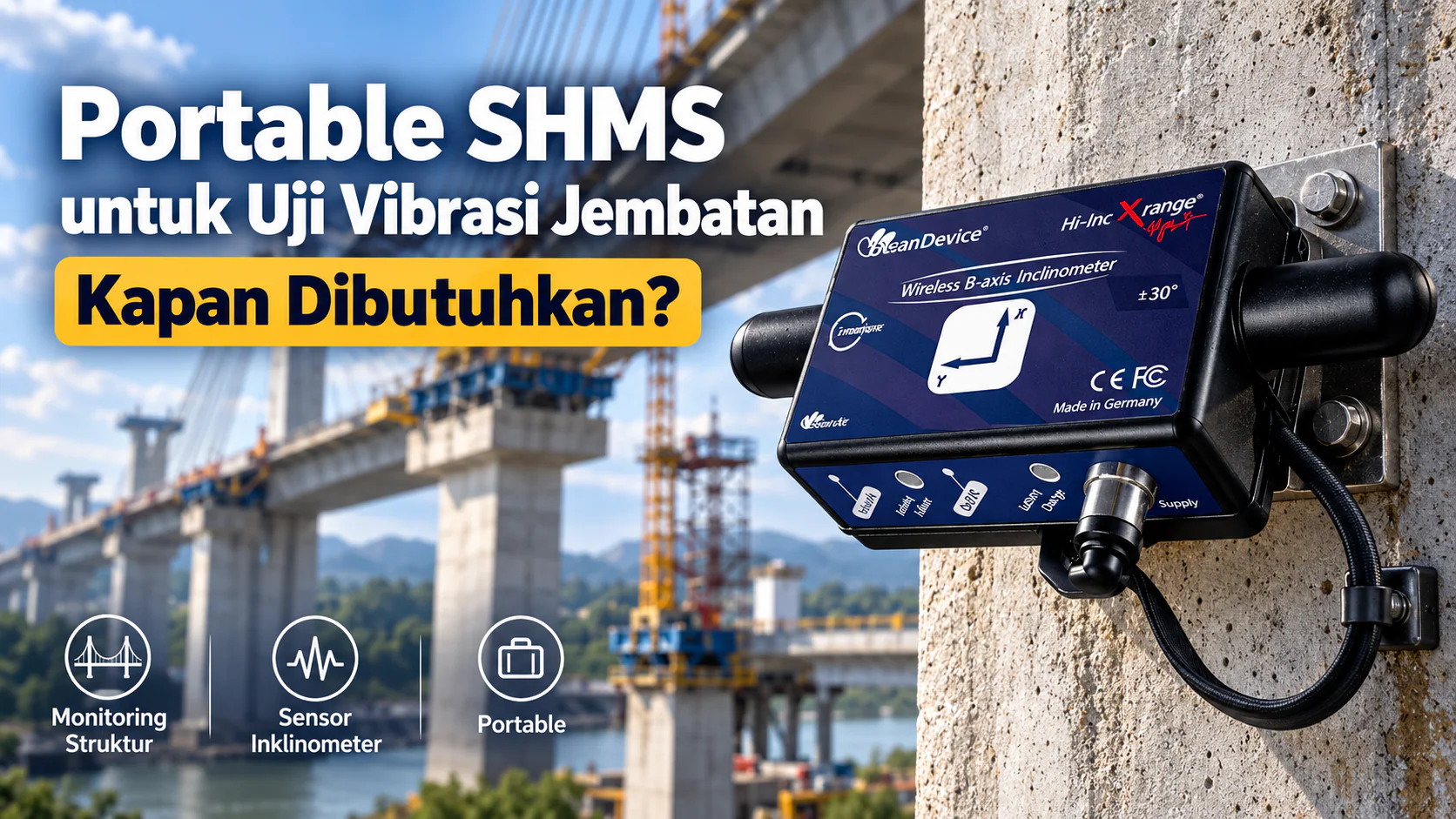
Vibration in a bridge does not necessarily indicate structural damage. However, when vibration patterns change, the structure responds differently, or objective data is needed to support an engineering assessment, a Portable Structural Health Monitoring System (SHMS) can help engineers “listen” to how a bridge responds to loads.
Depok - Traffic moves across bridges almost continuously. Passenger vehicles pass in large numbers, followed by buses and heavy trucks that impose different loads on the structure. At the same time, bridges are exposed to temperature changes, wind, rainfall, and other environmental influences.
Not all of these effects can be evaluated through visual inspection alone.
Cracks in concrete, corrosion, damaged joints, or other visible defects may be identified during routine inspections. But understanding how a bridge vibrates when vehicles pass, how much acceleration occurs, whether certain parts of the structure experience changes in inclination, or how specific structural elements respond to loads requires measurement.
This is where a Structural Health Monitoring System (SHMS) becomes relevant.
PT Luwes Inovasi Mandiri develops and implements structural monitoring systems using a range of sensors, including accelerometers, tiltmeters or inclinometers, strain gauges, and other measurement instruments depending on the structure and the objective of the assessment.
Luwes’ project portfolio includes bridge monitoring and structural testing projects using Portable SHMS, as well as bridge vibration measurements involving accelerometers and gateways.
Reading a Bridge Through Its Vibration
Every structure has a dynamic response when subjected to forces.
When a vehicle crosses a bridge, for example, the deck and other structural components experience small movements. These responses generate vibrations that can be recorded using an accelerometer.
The sensor does more than simply indicate whether a bridge is vibrating.
Acceleration data recorded over time can be processed to identify characteristics such as vibration amplitude, dominant frequencies, and changes in structural response under different loading conditions.
In structural engineering, changes in these dynamic characteristics may provide useful information for further evaluation.
However, vibration data should not be treated as a stand-alone diagnosis of structural damage. The results should be evaluated alongside other information, including the bridge design, structural materials, visual inspection findings, span configuration, loading conditions, maintenance history, and other engineering assessments.
Portable SHMS is therefore best understood as a tool for obtaining objective data about structural behaviour.
Why Use a Portable System?
Not every bridge requires a permanently installed monitoring system.
In many cases, the primary requirement is to conduct measurements during a specific period. For example, bridge owners or engineers may want to understand how a structure responds to passing vehicles, evaluate the bridge following repair works, collect supporting data for an inspection, or compare structural behaviour at different times.
A portable system provides greater flexibility for these purposes.
The equipment can be transported to the site, sensors can be installed at selected measurement points, and data can be collected during the assessment period.
Once the measurement campaign has been completed, the same system can be relocated to another section or another structure.
In previous Portable SHMS applications by Luwes, measurement configurations have included combinations of accelerometers and tiltmeters. Other projects have involved additional instruments such as strain gauges, laser distance sensors, load cells, and ultrasonic sensors, depending on the parameters being evaluated.
When Is Bridge Vibration Testing Needed?
There is no single condition that automatically means every bridge must undergo Portable SHMS testing. The need for monitoring should be determined by the objective of the assessment and by qualified structural engineers.
However, several situations can make vibration monitoring particularly useful.
One is establishing baseline data.
Measurements taken under known conditions can provide a reference describing how the bridge responds at a particular point in time. Similar measurements conducted later can then be compared with the original baseline.
Another situation is after rehabilitation or structural works.
When components are replaced, reinforcement works are completed, or the structure undergoes major modifications, measurements can help document the bridge's behaviour after the work.
Portable SHMS can also be relevant when there is a change in operational conditions.
Increasing traffic volumes, heavier vehicles, or changes in how a bridge is used may justify additional structural assessment.
Another application is supporting conventional bridge inspections.
Visual inspections remain an essential part of bridge management, but not every structural response can be seen with the naked eye. Sensor measurements can provide additional information to complement field observations.
Portable monitoring can also serve as an initial assessment before installing a permanent SHMS.
By conducting temporary measurements first, engineers can identify which parameters, sensor types, and monitoring locations are most relevant before developing a long-term monitoring system.
More Than Installing an Accelerometer
An effective vibration assessment begins well before a sensor is attached to the bridge.
The first step is defining the purpose of the measurement.
Is the objective to understand the bridge's response to normal traffic? To establish a baseline? To compare structural behaviour before and after rehabilitation? Or to support a specific engineering study?
From these questions, engineers can determine the appropriate sensor locations, number of monitoring points, parameters to be recorded, sampling frequency, measurement duration, and data-processing methods.
Accelerometers can be installed at locations considered representative of the structural response. If changes in inclination also need to be observed, tiltmeters or inclinometers can be added.
Where strain in a particular structural member is relevant, strain sensors may also be used.
The resulting measurements are collected through data-acquisition equipment or gateways before being processed and analysed.
This approach is what distinguishes structural monitoring from simply installing sensors.
Turning Data into Engineering Information
The real value of an SHMS does not come from producing large numbers of graphs.
Its value lies in helping engineers understand how a structure behaves.
Consistent measurements make it possible to compare responses between monitoring points, different loading conditions, and different observation periods. If significant changes are detected, the results may support decisions on whether additional inspections, detailed engineering assessments, or further structural investigations are required.
PT Luwes Inovasi Mandiri has experience implementing SHMS technology for bridges and transportation infrastructure. The company's portfolio includes Portable Structural Health Monitoring Systems for the Directorate of Bridges under Indonesia's Ministry of Public Works, bridge vibration measurements using accelerometers and gateways, and structural monitoring using combinations of accelerometers, tiltmeters, and strain gauges.
Ultimately, the question of when Portable SHMS is needed cannot be answered solely by looking at the age of a bridge.
The more important question is: what information do bridge owners and engineers need to better understand the condition and behaviour of the structure?
When visual inspections need to be supported by dynamic measurements, when structural behaviour must be compared over time, or when a bridge's response to loading needs to be recorded objectively, Portable SHMS can become an important tool in the engineering assessment process.
PT Luwes Inovasi Mandiri provides Portable SHMS Assessment services to support sensor selection, measurement-point planning, data acquisition configuration, and monitoring-system development according to the characteristics of the structure and the objectives of the assessment.
PT Luwes Inovasi Mandiri
Industrial IoT & Monitoring Solutions
🌐 www.luwesinovasimandiri.com
📷 Instagram: @luwesinovasimandiri
💼 LinkedIn: Luwes Inovasi Mandiri
📘 Facebook: LuwesSolutions
📲 whatsapp : +62 811-8185-5558
📍 Kantor Luwes : Depok, West Java, Indonesia
Tags:
Thinking of using this at your site?
Start with the equipment and approaches below. Your site requirements determine the right setup.
- Structural condition monitoringExplore monitoring options, sensor placement and how changes are interpreted.
- A system for your requirementsDiscuss requirements that do not fit a single catalogue product.
- Explore installation regionsExplore installations grouped by region. Your project may need a different setup.