Protecting Tunnel Structural Integrity Through Continuous Monitoring
A Structural Health Monitoring System integrates sensors, dataloggers, telemetry, baseline data, and dashboards to help engineers monitor changes in tunnel structural conditions over time.
Tunnels are critical infrastructure assets designed for long-term operation. During their service life, underground structures can be influenced by structural loads, ground movement, environmental temperature changes, construction activities, and surrounding traffic.
Visual inspection remains an important part of maintenance. However, for infrastructure that requires more intensive observation, periodic inspections may not fully capture changes that occur between inspection periods.
This is where a Structural Health Monitoring System (SHMS) plays an important role.
SHMS integrates sensors, data acquisition systems, telemetry, servers, and monitoring dashboards to record selected structural parameters in a measurable and documented manner.
From Periodic Inspection to Time-Series Data
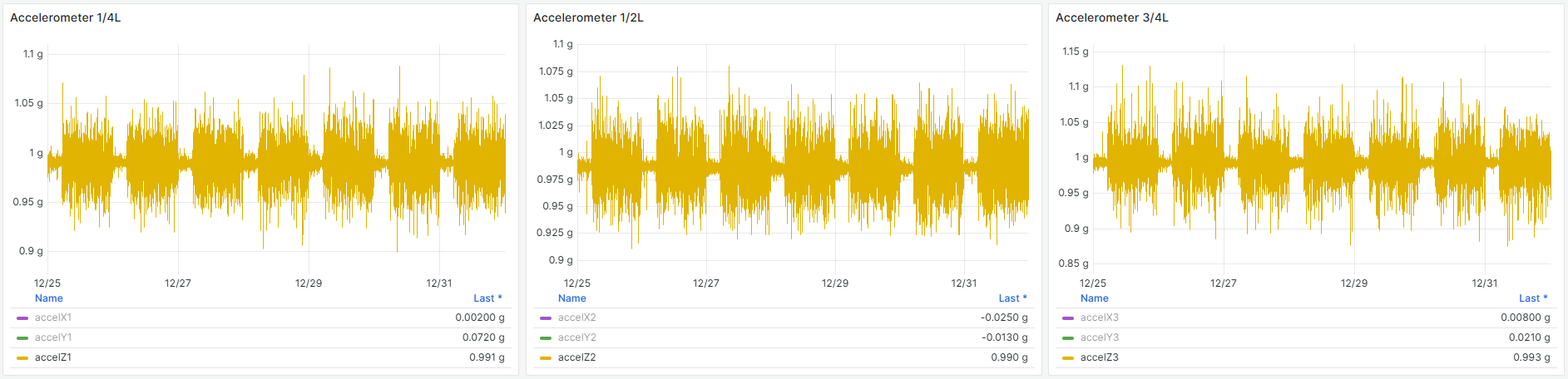
Figure 1. Accelerometer measurements recorded over time form a time-series that allows changes in vibration response to be observed.
SHMS works by installing sensors at locations determined by engineering requirements and monitoring objectives. The recorded measurements form a time-series, allowing engineers to observe how selected parameters change over time.
This information can be used as one of several data sources in structural condition assessment and maintenance planning.
SHMS does not replace engineers or field inspections. Instead, it provides measured data that helps make evaluation more consistent and traceable.
Parameters That Can Be Monitored in Tunnels
There is no single SHMS configuration suitable for every tunnel. Sensor selection should consider structural design, ground conditions, environmental characteristics, monitoring objectives, and engineering assessment.
Commonly monitored parameters include:
Deformation and displacement, to observe changes in structural position;
Strain, to measure changes in material or structural elements;
Tilt, to monitor changes in inclination;
Temperature and humidity, as supporting environmental parameters;
Vibration, to record structural response from traffic, construction activities, or other relevant vibration sources.
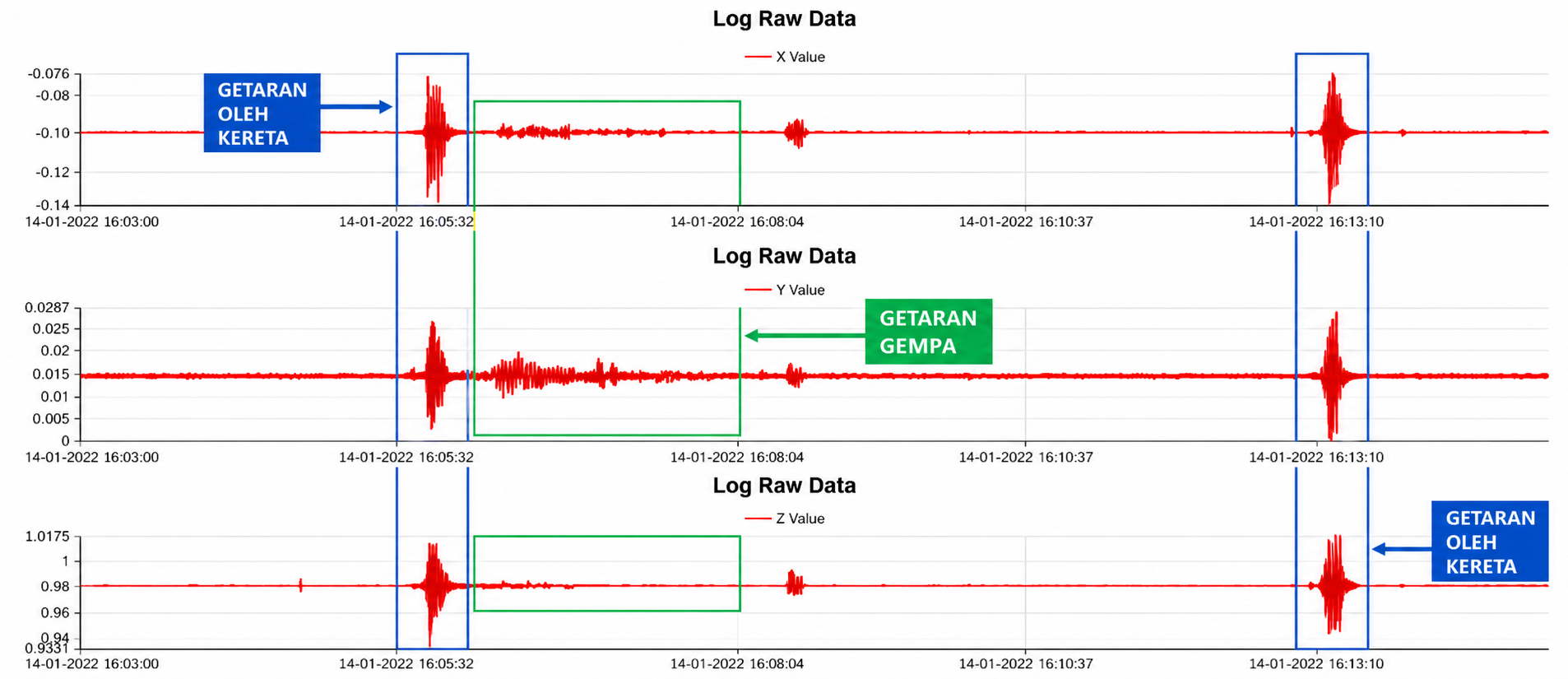
Figure 2. The accelerometer chart shows different vibration response patterns recorded during train activity and other vibration events within the tunnel environment.
The effectiveness of SHMS is not determined by the number of sensors installed, but by how relevant each parameter is to the monitoring objective.
Why Baseline Data Matters
Baseline data is an important component of SHMS implementation.
Initial measurements collected after installation and commissioning provide a reference for comparing future conditions. Without a clear baseline, small changes in displacement, strain, tilt, or vibration can be more difficult to interpret in context.
The initial phase should therefore include sensor verification, signal quality checks, documentation of initial structural conditions, and recording of activities occurring during baseline measurement.
A baseline does not mean that one condition is permanently considered “normal.” Its role is to provide a reference point so that future changes can be interpreted more meaningfully.
Telemetry and Underground Communication Challenges
Sensor data is received by a datalogger or data acquisition device and then transmitted to a server using a communication system suited to the site.
Tunnel environments present unique communication challenges. Structural materials, tunnel length, panel location, humidity, and limited wireless signal coverage must all be considered when designing the network.
Systems may use wired communication, local networks, gateways, or a combination of methods. Power supply, equipment protection, and local data storage should also be planned to support reliable operation.
Dashboard as a Tool for Engineering Evaluation
An SHMS dashboard can display:
parameter trends over time;
sensor locations or tunnel layouts;
historical data;
communication status; and
indicators based on predefined monitoring thresholds.
If a parameter exceeds a defined threshold, the system can be configured to send an alert.
However, an alert does not automatically mean that the structure is in a dangerous condition. The measurement should be reviewed together with historical data, sensor condition, ongoing activities, environmental conditions, and evaluation by authorized engineers.
For vibration monitoring, not every spike carries the same meaning. Train operations, construction activities, or other vibration sources can produce different signal characteristics. Accelerometer data should therefore be interpreted together with timing, baseline conditions, and operational context.
SHMS as Part of Infrastructure Management
Implementing SHMS involves more than installing sensors. Monitoring points, installation methods, communication systems, data intervals, storage, alert mechanisms, and maintenance should be designed as one integrated system.
Different tunnel types, including road tunnels, railway tunnels, MRT tunnels, and utility tunnels, may require different monitoring approaches depending on their technical objectives.
For this reason, SHMS design should begin with engineering requirements and the parameters that genuinely need to be observed.
Integrated Structural Health Monitoring Solutions
PT Luwes Inovasi Mandiri provides Structural Health Monitoring systems that can be configured according to project requirements, covering sensors, data acquisition devices, communication systems, servers, and monitoring dashboards.
The approach can be applied to tunnels as well as bridges, buildings, and other infrastructure requiring periodic structural monitoring.
With a system designed around actual engineering needs, sensor data can become a historical record that helps engineers understand changes in structural conditions over time.
If your institution or company is planning a Structural Health Monitoring System, discuss your sensor, baseline, telemetry, and dashboard requirements with PT Luwes Inovasi Mandiri through an SHMS Solution Briefing.
PT Luwes Inovasi Mandiri
Industrial IoT & Monitoring Solutions
🌐 www.luwesinovasimandiri.com
📷 Instagram: @luwesinovasimandiri
💼 LinkedIn: Luwes Inovasi Mandiri
📘 Facebook: LuwesSolutions
📲 whatsapp : +62 811-8185-5558
📍 Kantor Luwes : Depok, West Java, Indonesia