Structures Are Never Completely Still: Understanding the Role of SHMS in Infrastructure Monitoring
Published
PT Luwes Inovasi Mandiri
Contributor: Ndy
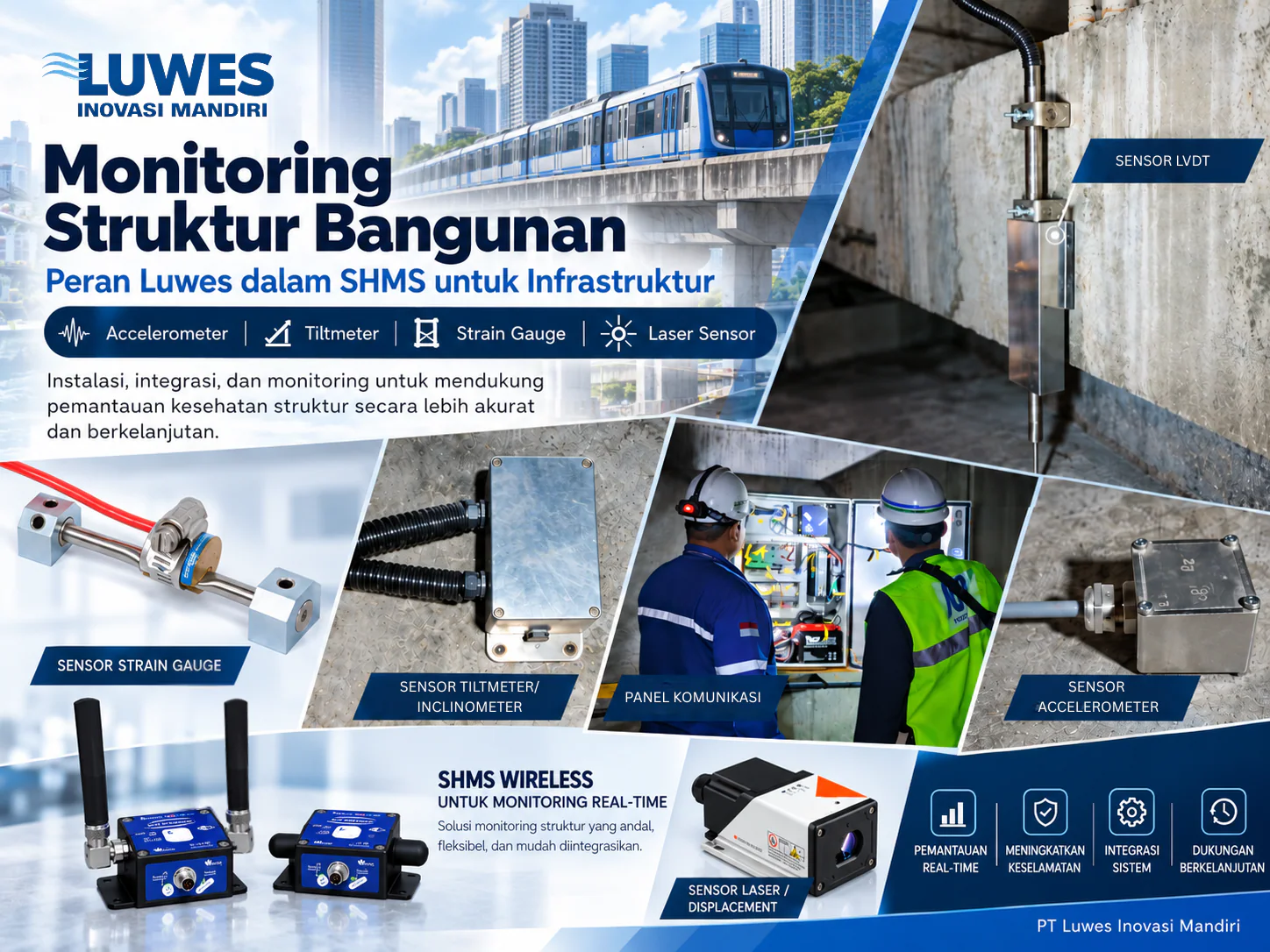
Structural Health Monitoring System (SHMS) helps infrastructure owners understand how structures behave over time by continuously measuring parameters such as vibration, strain, inclination, displacement, water pressure, and water level. Applied to bridges, buildings, elevated and tunnel MRT structures, dams, and other critical infrastructure, SHMS supports more focused inspection and maintenance by identifying changes from established structural behavior. The system complements—not replaces—engineering assessment and field inspection.
At first glance, bridges, buildings, dams, elevated structures, and tunnels appear solid and motionless. In reality, however, every structure continuously responds to loads and environmental conditions throughout its service life.
Bridges vibrate as vehicles pass over them. High-rise buildings can undergo slight movement due to wind. Elevated structures are repeatedly subjected to dynamic loads from passing trains. MRT tunnels interact with the surrounding soil while also receiving vibrations generated by daily operations. Dams, meanwhile, must continuously withstand large volumes of water that exert pressure on the dam body and its foundation.
Most of these responses are part of normal structural behavior. What requires attention is when a change becomes progressively larger, develops over time, or begins to differ from previously observed patterns.
This is where a Structural Health Monitoring System (SHMS) plays an important role.
Many structural changes occur on a scale too small to be detected by visual inspection alone. On bridges, changes may occur in bearings, joints, spans, or piers. In buildings, monitoring may focus on inclination, vibration, and deformation. On elevated MRT structures, repeated train movements generate dynamic responses in girders, piers, and supporting elements. In MRT tunnels, monitoring can focus on displacement, inclination, geometric changes, and structural vibration.
Dams present another set of challenges. In addition to structural deformation and movement, water pressure is an important parameter. As reservoir water levels change, the hydrostatic force acting on the dam also changes. Water can also migrate through the dam material, foundation, and surrounding soil layers. For this reason, dam monitoring cannot rely solely on visual inspection.
Dam monitoring may involve piezometers to measure pore-water pressure, water-level sensors or Automatic Water Level Recorders (AWLR) to monitor reservoir levels, and other instruments to observe deformation, inclination, displacement, and seepage. These measurements become more meaningful when interpreted together. For example, changes in water pressure can be compared with reservoir-level fluctuations and structural movement to determine whether the dam is still responding according to its established pattern.
SHMS itself does not rely on a single type of sensor. Accelerometers measure vibration and dynamic response. Strain gauges measure material strain. Tiltmeters or inclinometers detect changes in angle or inclination. LVDTs measure linear displacement with high precision, while laser displacement sensors can observe changes in distance without direct physical contact.
Sensor selection and placement are therefore critical. Sensors are not installed simply to increase the number of measurement points. Their locations should be determined according to the structural design, inspection findings, critical areas, and the parameters that need to be monitored.
Once installed, measurements are collected by data loggers and transmitted to a server and monitoring dashboard. Operators can review vibration, strain, tilt, displacement, water pressure, water level, and other parameters in real time as well as through historical trends.
In practice, a single measurement does not necessarily indicate a problem. An increase in vibration as an MRT train passes, for example, may simply represent a normal structural response. Likewise, increasing water pressure in a dam may correspond to a rise in reservoir level.
What matters is the pattern of change over time.
For infrastructure agencies and operators, this information can make inspection and maintenance activities more focused. SHMS data can help determine which areas should be inspected first, when additional inspections are warranted, and how structural conditions change before and after maintenance work.
SHMS therefore does not replace engineers or field inspections. Instead, it complements them by providing continuous data that can strengthen technical assessments.
PT Luwes Inovasi Mandiri integrates sensors, data loggers, communication systems, and monitoring dashboards for a range of applications, including bridges, buildings, elevated MRT structures, MRT tunnels, dams, retaining walls, industrial structures, and other critical infrastructure.
Ultimately, the purpose of structural monitoring is not to keep a structure completely motionless. Structures are designed to respond to loads and their environment. The important question is whether that response remains within its expected pattern—or has begun to change in a way that requires further investigation.
Tags:
Thinking of using this at your site?
Start with the equipment and approaches below. Your site requirements determine the right setup.
- Structural condition monitoringExplore monitoring options, sensor placement and how changes are interpreted.
- A system for your requirementsDiscuss requirements that do not fit a single catalogue product.
- Explore installation regionsExplore installations grouped by region. Your project may need a different setup.