Weather and Water-Level Sensor Calibration: Why Accurate Data Matters Before It Drives Decisions
Published
PT Luwes Inovasi Mandiri
Contributor: YP
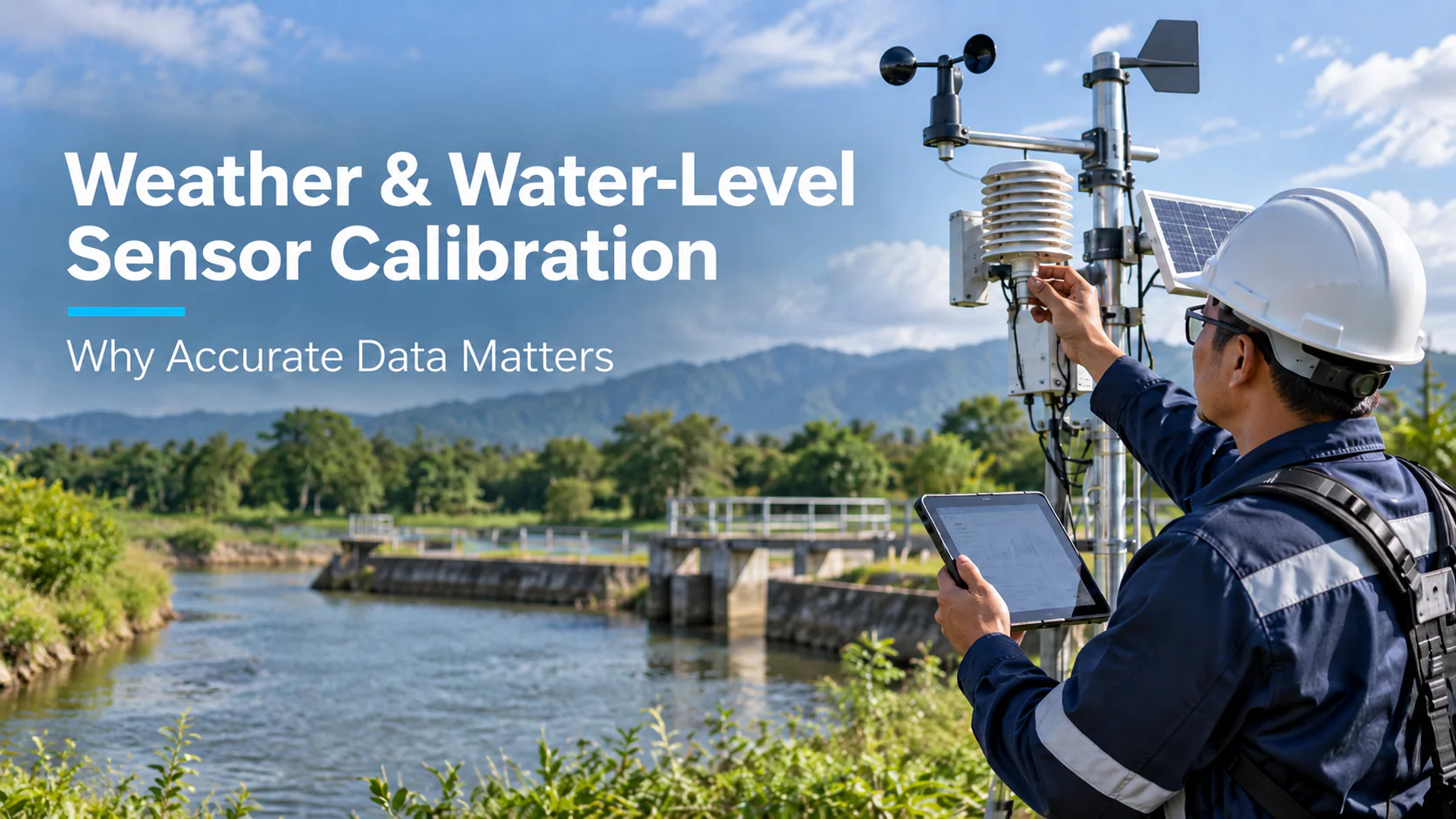
Regular calibration and maintenance of weather and water-level sensors help ensure monitoring data remains accurate, reliable, and suitable for operational decision-making.
Depok - Behind every temperature reading, rainfall record, wind-speed measurement, or water-level value displayed on a monitoring dashboard lies a fundamental question: Is the sensor still measuring field conditions accurately?
The question matters because monitoring systems do more than collect data. Their readings can support weather analysis, river and reservoir monitoring, infrastructure operations, environmental management, and even early warning systems.
When sensor readings begin to drift from actual conditions, the error can quietly carry over into every subsequent process. The dashboard may still function. Data may continue to arrive at the server. Yet the numbers being used for analysis and decision-making may no longer represent what is truly happening in the field.
This is why sensor calibration and maintenance are essential parts of any reliable monitoring system.
Sensors Operate Continuously in Changing Environments
An Automatic Weather Station, or AWS, generally operates around the clock using several sensors to measure parameters such as air temperature, relative humidity, atmospheric pressure, rainfall, wind speed, wind direction, and other meteorological variables.
Water-level monitoring systems such as an Automatic Water Level Recorder (AWLR) may use radar, ultrasonic, or pressure-based sensors to measure changes in rivers, irrigation canals, reservoirs, wells, or coastal waters.
Unlike equipment in a controlled laboratory, however, field sensors operate under constantly changing environmental conditions.
Heat, rain, high humidity, dust, corrosion, sediment, shifting mounting structures, vibration, unstable power supply, and communication problems can all affect monitoring equipment over time. Some sensors may also experience gradual changes in their measurement characteristics after long-term operation.
This means that a sensor that is still powered on is not necessarily a sensor that is still performing correctly.
A water-level sensor, for example, may continue transmitting readings every minute. But if its mounting position shifts by several centimetres, the measurements can develop an offset even though the sensor itself remains operational.
The same applies to tipping-bucket rainfall sensors. Dirt inside the funnel, mechanical obstruction, or changes in the bucket mechanism can influence the recorded rainfall.
Calibration Is More Than Checking Whether a Sensor Works
Calibration is essentially a process of comparing an instrument's readings with a known reference to identify measurement deviation.
The method differs depending on the sensor being evaluated.
Weather sensors may require verification of temperature, humidity, atmospheric pressure, rainfall, or wind measurements using appropriate reference instruments and procedures.
For water-level systems, verification may involve comparing sensor readings with manual measurements, a staff gauge or peilschaal, surveyed reference elevations, or other established benchmarks.
Reference elevation is particularly important in water-level monitoring. A sensor may perform correctly from an electronic standpoint, yet the data can still become misleading if the sensor position, reference datum, or installation elevation has changed.
The World Meteorological Organization places testing, calibration, intercomparison, and quality assurance among the key elements needed to maintain reliable meteorological observations. Consistency in measurement is essential because observation data may later be used for forecasting, warning systems, operational planning, and long-term analysis.
Maintenance and Calibration Need to Work Together
Calibration alone cannot guarantee a reliable monitoring station.
A sensor may still meet its measurement specifications, while the overall system suffers from a weak battery, damaged solar panel, poor grounding, loose cabling, communication failure, or malfunctioning data logger.
For this reason, maintenance should cover the entire monitoring chain.
In AWS and AWLR installations, periodic inspection can include the physical condition of the sensors, cleanliness, mounting alignment, power supply, battery performance, solar panel output, grounding systems, communication devices, data loggers, and the consistency of data received by the server.
PT Luwes Inovasi Mandiri has handled a range of projects involving weather and water monitoring systems, including AWS sensor calibration, weather and tidal sensor calibration, maintenance checks, water-level sensor replacement, battery replacement, solar-panel servicing, and communication network restoration.
These activities highlight an important point: maintaining data quality is not limited to checking a dashboard from the control room. Many problems can only be identified through direct inspection in the field.
Reliable Data Begins with Well-Maintained Sensors
The development of Internet of Things technology has made it possible to transmit thousands of field measurements to central servers every day. Modern dashboards can present this information almost in real time.
But more data does not automatically mean better data.
A sensor that records one measurement every minute may generate 1,440 data points per day. If that sensor is biased, however, it can also generate 1,440 inaccurate readings every day.
This is why calibration should not be treated only as a corrective action after a sensor fails.
Periodic inspection and calibration can become part of a preventive maintenance strategy, especially for monitoring stations that operate continuously or provide data for operational decisions.
For long-term observation networks, proper documentation is equally important. Calibration records, maintenance history, sensor replacements, configuration changes, and field verification results help operators understand whether changes in data reflect real environmental conditions or changes in the monitoring equipment itself.
From Sensor Reading to Trusted Information
A monitoring system should not be judged only by how many sensors are installed or how sophisticated its dashboard appears.
Its real value lies in the confidence users can place in the data it produces.
For weather stations, water-level monitoring systems, tidal stations, and other environmental monitoring infrastructure, regular calibration and maintenance help ensure that measurements remain consistent, traceable, and suitable for operational use.
PT Luwes Inovasi Mandiri provides Calibration & Maintenance Services for weather and water-level monitoring systems, covering sensor inspection, measurement verification, maintenance of supporting equipment, communication-system checks, and overall monitoring performance evaluation.
For monitoring equipment that has been operating continuously in the field, periodic inspection should not wait until the system stops working.
Because in a monitoring system, the most critical failure is not always a sensor that goes offline.
Sometimes, it is a sensor that keeps transmitting data—but no longer measures the actual condition accurately.
Schedule Sensor Calibration & Maintenance with PT Luwes Inovasi Mandiri.
PT Luwes Inovasi Mandiri
Industrial IoT & Monitoring Solutions
🌐 www.luwesinovasimandiri.com
📷 Instagram: @luwesinovasimandiri
💼 LinkedIn: Luwes Inovasi Mandiri
📘 Facebook: LuwesSolutions
📲 whatsapp : +62 811-8185-5558
📍 Kantor Luwes : Depok, West Java, Indonesia
Tags:
Thinking of using this at your site?
Start with the equipment and approaches below. Your site requirements determine the right setup.
- Equipment maintenance and checksDiscuss system checks, calibration and maintenance requirements.
- AWS: automatic weather stationChoose weather measurements that suit your field requirements.
- AWLR: water level recorderSee how water levels are measured and how installation depends on the site.