Irrigation Modernization: Integrating AWLR and Actuators for More Responsive Water Gate Operations
Published
PT Luwes Inovasi Mandiri
Contributor: YP
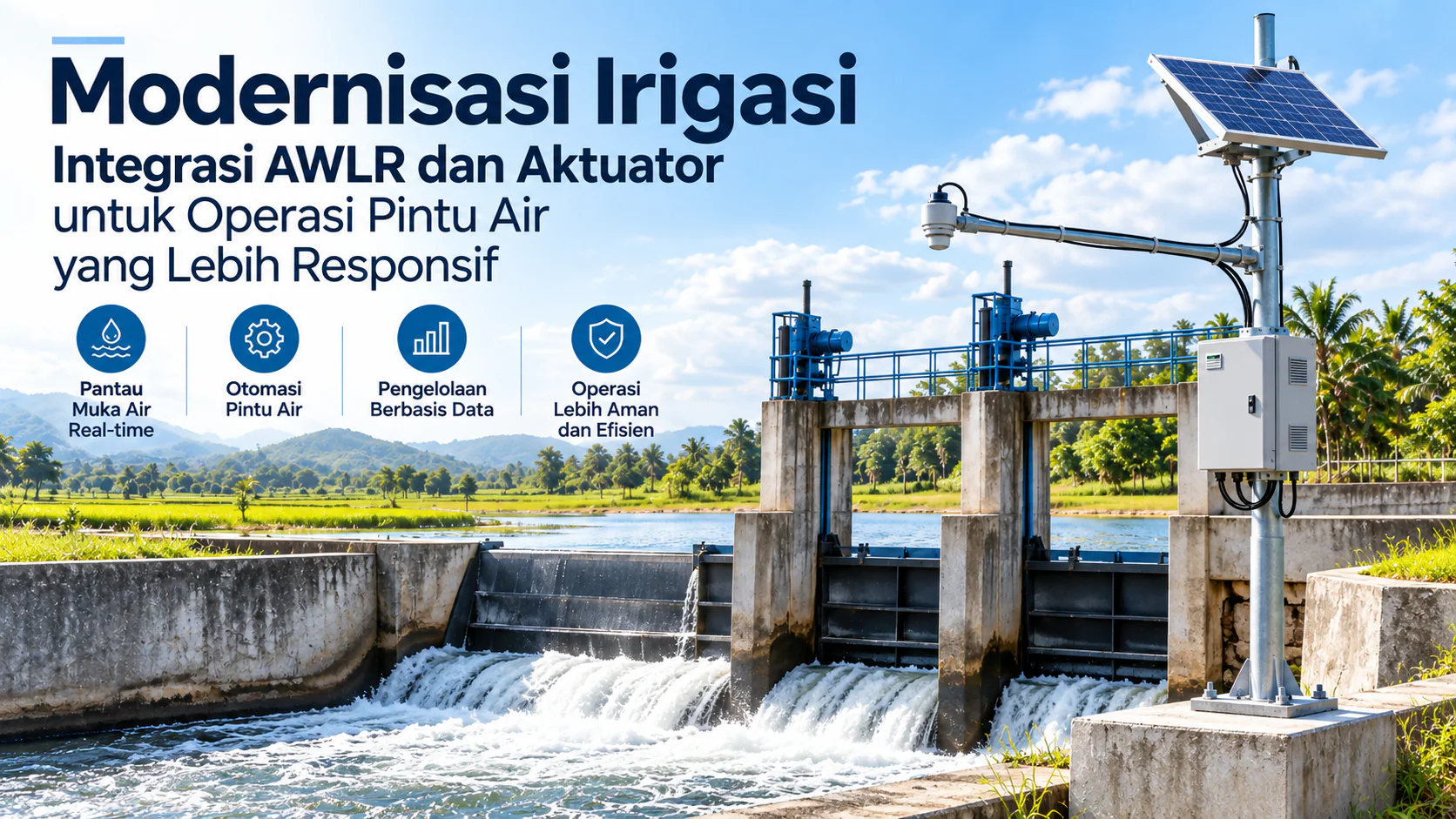
Irrigation management can no longer rely solely on water-level readings and separate manual gate operations. Integrating AWLR sensors, actuators, telemetry, and control systems creates a more responsive, measurable, and data-driven approach to water distribution.
Depok - Water distribution is one of the most critical aspects of irrigation network management. Changes in river discharge, weather conditions, agricultural water demand, and elevation differences between areas require operators to continuously adjust water gate openings.
In conventional systems, field personnel usually monitor water levels and then adjust gates based on observations made on site. This approach can still work, but it becomes increasingly limited when the monitored area expands and water conditions change rapidly.
Advances in telemetry technology now allow this process to be managed differently. An Automatic Water Level Recorder (AWLR) can be integrated with water gate actuators and automated control systems, turning water-level data from simple monitoring information into a basis for operational action.
From Water-Level Monitoring to Gate Control
An AWLR is used to measure water levels at regular intervals. Sensors installed in rivers, irrigation canals, weirs, reservoirs, or water-control structures transmit measurements to a data logger, which then sends the information to a server.
The data can be displayed on a monitoring dashboard, allowing operators to observe changes in water levels over time.
In a Smart Water Control system, this function goes a step further. AWLR data becomes one of the key inputs used to manage water gate operations.
When the water level reaches a predetermined threshold, the system can issue an alert to the operator. In a more integrated configuration, control commands can also be sent directly to an actuator to adjust the gate position.
The actuator converts control instructions into mechanical movement, such as opening or closing the gate to a specified percentage.
The overall system can therefore operate through the following sequence:
AWLR sensor → data logger/RTU → telemetry communication → server → dashboard and control logic → actuator → water gate
This integration is what transforms a conventional monitoring system into a more advanced water-control system.
Decisions Based on More Than a Single Measurement
Automating water gates does not mean that a gate should immediately move whenever the water level changes. A reliable control system requires clearly defined operational rules.
For example, the system may use minimum, normal, alert, and maximum water-level thresholds. Gate movement can also be controlled using predefined set points, tolerance ranges, or hysteresis to prevent the actuator from repeatedly opening and closing when the water level fluctuates around a threshold.
Operators should also retain the ability to select between manual, semi-automatic, and automatic operating modes, depending on operational requirements.
Additional information can also be incorporated into the decision-making process, including rainfall data from an Automatic Rainfall Recorder (ARR), upstream and downstream water levels, and weather forecast information.
With this approach, gate operation is no longer based on a single sensor reading.
Improving Irrigation Network Supervision
Another major advantage of an integrated system is centralized monitoring.
Operators can observe water levels, gate positions, communication status, device conditions, and historical gate movements through a monitoring dashboard.
Each action can also be recorded. Information such as when a gate was opened, the percentage of opening, who issued the command, and how the water level changed afterward can become part of the operational record.
This historical data is valuable because irrigation management is not only about current conditions. Water-use patterns across different planting seasons can be analyzed to improve future water-distribution strategies.
Safety Remains Essential
Although automation offers significant benefits, water-gate control systems must still be designed with safety as a priority.
Possible failures involving sensors, communication networks, power supply, or actuators need to be considered from the beginning. For this reason, systems can be equipped with alarms, watchdog functions, actuator travel limits, manual override mechanisms, and appropriate fail-safe procedures.
Field verification of sensor readings also remains important.
Technology should help operators make faster and more consistent decisions, rather than completely replacing human supervision.
Toward Data-Driven Water Management
PT Luwes Inovasi Mandiri develops integrated solutions combining AWLR, telemetry, actuators, dashboards, and control systems to support the modernization of water-resource and irrigation management.
Each implementation must be adapted to the characteristics of the site. Gate type, canal dimensions, existing mechanical systems, operational requirements, power availability, communication networks, and water-management procedures all need to be assessed before implementation.
Irrigation modernization is therefore not simply about replacing manual gate operations with electric motors.
The more important transformation is making field conditions measurable, recorded, connected, and actionable.
When sensors provide reliable real-time information and actuators execute operational decisions through appropriate control logic, irrigation management can move toward a system that is more responsive, measurable, and efficient.
Schedule an irrigation modernization assessment with PT Luwes Inovasi Mandiri to evaluate the most suitable AWLR, actuator, telemetry, and control-system configuration for your irrigation network and water-control infrastructure.
PT Luwes Inovasi Mandiri
Industrial IoT & Monitoring Solutions
🌐 www.luwesinovasimandiri.com
📷 Instagram: @luwesinovasimandiri
💼 LinkedIn: Luwes Inovasi Mandiri
📘 Facebook: LuwesSolutions
📲 Whatsapp : +62 811-8185-5558
📍 Luwes Office : Depok, West Java, Indonesia
Tags:
Thinking of using this at your site?
Start with the equipment and approaches below. Your site requirements determine the right setup.
- AWLR: water level recorderSee how water levels are measured and how installation depends on the site.
- SCADA: monitoring and controlReview how sensors, data displays and required controls can work together.
- Farm monitoringConnect weather and field data with farming needs.