Protecting Industrial Water Quality Through Real-Time Online Environmental Monitoring
Published
PT Luwes Inovasi Mandiri
Contributor: AD
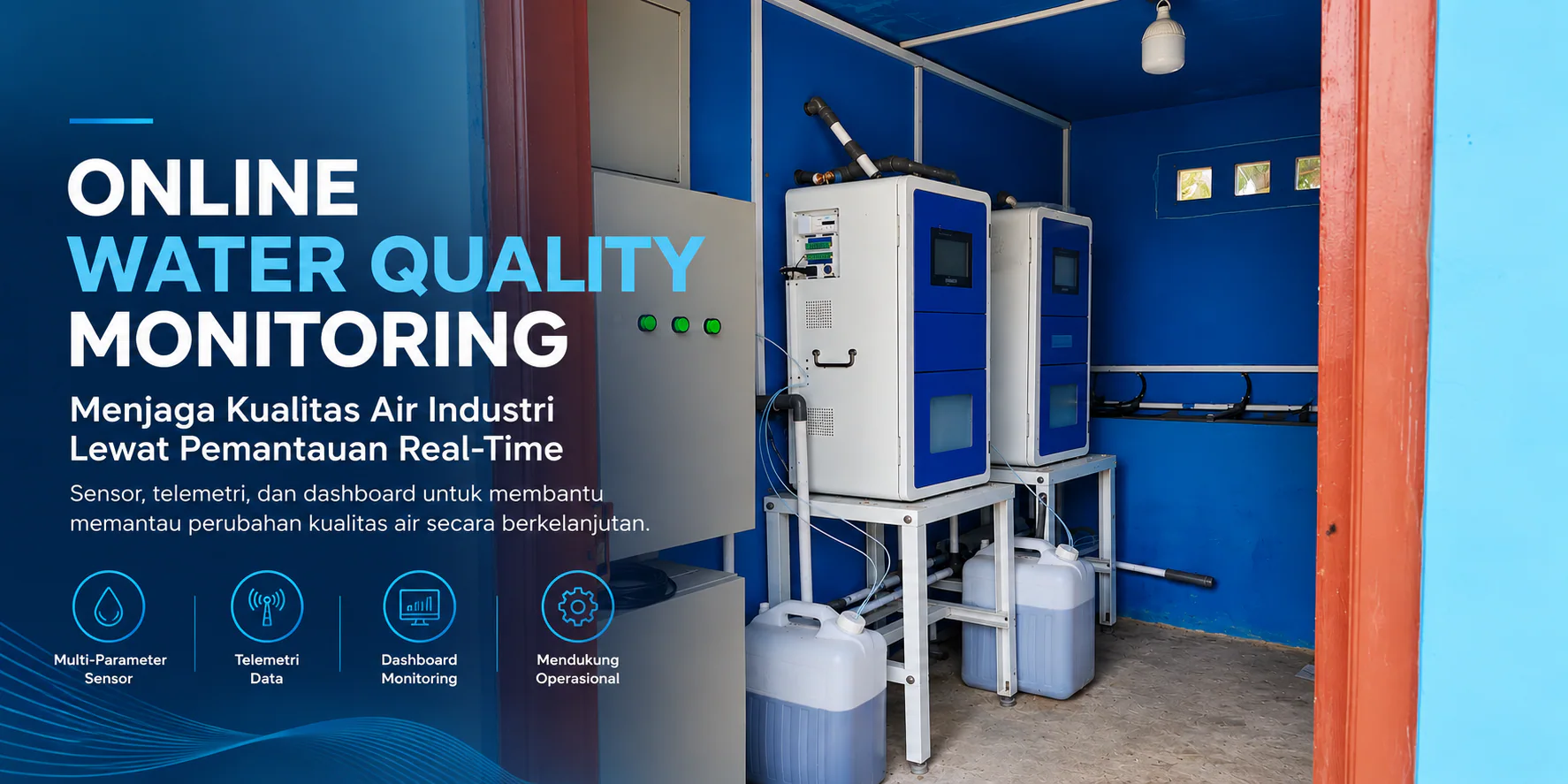
Sensor- and telemetry-based industrial water quality monitoring helps consolidate data from multiple monitoring points to support more measurable and documented mining and plant operations.
Mining operations and manufacturing facilities require consistent environmental monitoring. Water quality parameters at inlet points, outlets, settling ponds, and process lines can change due to operational dynamics and environmental conditions.
Manual testing and laboratory sampling remain important, but they have limitations in capturing changes that occur between scheduled sampling periods.
For this reason, industrial environmental monitoring based on sensors and telemetry is increasingly used to help operational teams obtain field data that is periodic, documented, and easier to access.
From Manual Sampling to Automated Monitoring
Laboratory testing remains necessary for selected parameters using appropriate analytical methods. Online monitoring, meanwhile, provides continuity of field data.
Sensors are installed at locations selected according to process requirements or environmental monitoring objectives. Data is collected by a datalogger and transmitted through a telemetry network to a central server.
This allows operators to monitor changing conditions without continuously visiting each location. The recorded data forms a time-series that can help reveal trends and identify changes more quickly.
Water Quality Parameters That Can Be Monitored
Sensor selection should match the characteristics of the water and the monitoring objective.
Common parameters include:
pH, to monitor changes in acidity or alkalinity, including at locations with potential Acid Mine Drainage concerns;
Conductivity / EC, to provide information on electrical conductivity and dissolved ionic content;
TDS, to provide information on dissolved solids concentration, either through direct measurement or conductivity-based estimation depending on the instrument method;
Turbidity, to monitor changes in water clarity;
Dissolved Oxygen (DO), for biological treatment facilities or receiving-water monitoring; and
Water Level & Flow, to monitor water level, flow rate, or volume depending on the measurement configuration.
Monitoring effectiveness depends on the suitability of the sensor, water characteristics, and operational requirements.
Operational Challenges in Mining and Plant Environments
Mining and industrial environments can be challenging for field instruments.
Suspended solids, fouling, scaling, pH fluctuations, chemicals, and harsh environmental conditions can affect sensor performance.
For this reason, a monitoring system involves more than sensor selection. Installation design, panel protection, maintenance access, calibration, and automated cleaning systems—when appropriate for the sensor type—should also be considered.
Telemetry for Consolidating Monitoring Data
One of the main advantages of online monitoring is the ability to consolidate multiple monitoring locations into one platform.
Sensor data can be transmitted through cellular or other communication networks to a server and displayed through a monitoring dashboard.
A dashboard can show:
current parameter values;
trend and historical charts;
monitoring station locations;
sensor and communication status; and
indicators based on configured monitoring thresholds or reference values.
Data can also be integrated through APIs with operational platforms, SCADA, environmental monitoring systems, or internal company data systems.
Alerts Should Be Verified
When a parameter exceeds a configured monitoring threshold, the system can send a notification to operators.
However, an alert does not automatically indicate pollution or a process failure.
Changes in readings may be influenced by process conditions, fouling, calibration requirements, changes in water characteristics, or other environmental factors. Alerts therefore serve as a trigger for prompt verification.
Online Data and Laboratory Testing Complement Each Other
Online monitoring provides data continuity, while sampling and laboratory testing are used for selected parameters with appropriate analytical methods.
For compliance-related purposes, data interpretation should still consider measurement methods, calibration, sampling procedures, and applicable requirements.
Online monitoring is therefore most effective when combined with appropriate verification and testing procedures.
Industrial & Environmental Telemetry Solutions
PT Luwes Inovasi Mandiri provides water quality monitoring and telemetry systems for mining areas and plant operations, covering sensors, dataloggers, telemetry, servers, and monitoring dashboards.
Configurations can be adapted to water characteristics, monitoring parameters, site locations, communication networks, and integration requirements.
Build an environmental monitoring system that matches your process characteristics, water conditions, and operational needs. Discuss your sensor, telemetry, dashboard, and system integration requirements with PT Luwes Inovasi Mandiri through an Industrial Monitoring Assessment.
Tags:
Thinking of using this at your site?
Start with the equipment and approaches below. Your site requirements determine the right setup.
- Water quality monitoringDiscuss the water source, required measurements and sensor care.
- SCADA: monitoring and controlReview how sensors, data displays and required controls can work together.
- A system for your requirementsDiscuss requirements that do not fit a single catalogue product.