Global Weather Intelligence. Local Decisions.
Published
PT Luwes Inovasi Mandiri
Contributor: Odie
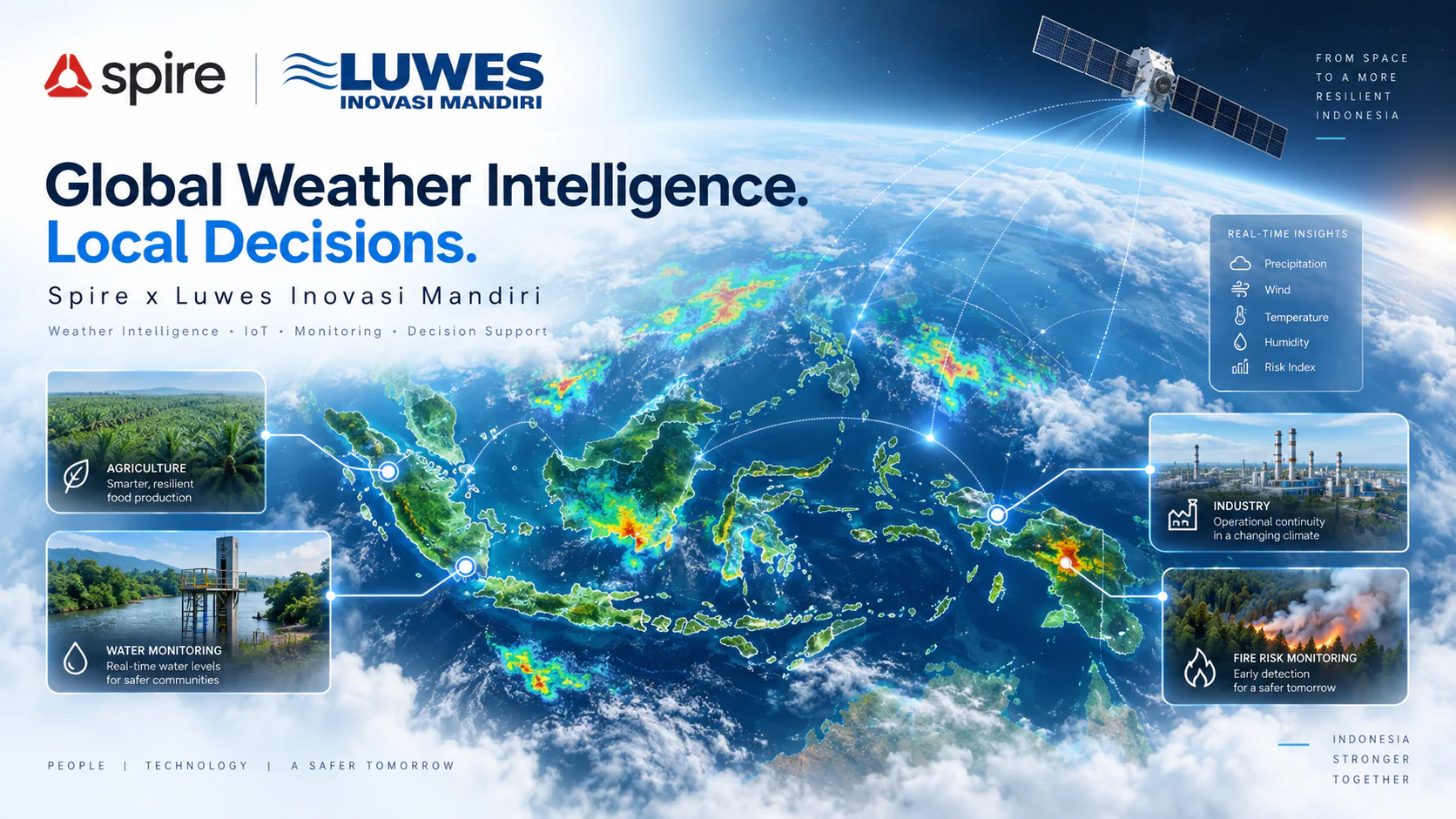
PT Luwes Inovasi Mandiri integrates Spire's weather intelligence with local technology and operational solutions to help organizations across Indonesia make faster, more informed, and data-driven decisions.
Spire x Luwes Inovasi Mandiri: Turning Weather Intelligence into Better Decisions
Weather affects almost every sector—from agriculture and water management to infrastructure, logistics, energy, and industrial operations. Yet having access to weather data alone is not enough. The real value begins when that data can be translated into information that supports actual operational decisions.
This is where Spire and PT Luwes Inovasi Mandiri come together.
By integrating Spire's global weather intelligence with Luwes' experience in IoT, telemetry, monitoring systems, data platforms, and decision-support solutions, weather information can become a practical part of day-to-day operations in Indonesia.
From Weather Data to Operational Intelligence
Modern organizations need more than a simple weather forecast.
They need to understand questions such as:
Will rainfall affect today's field operation?
How will weather conditions develop over the next several hours or days?
Is soil moisture still sufficient for agricultural activities?
Are atmospheric conditions increasing the potential for fire?
When is the best operational window for activities affected by weather?
How can weather information be connected with sensor and monitoring data already available in the field?
Luwes works to bridge this gap by transforming weather datasets into information that can be integrated into dashboards, APIs, monitoring platforms, alerts, maps, and decision-support systems.
Weather Intelligence Powered by Spire
Spire provides global weather data and forecasting capabilities that can support a wide range of operational applications.
Through Luwes' solutions, several types of weather information can be utilized, including:
High-Resolution Weather Forecast
High-resolution forecasts provide detailed information on upcoming atmospheric conditions. This can support operational planning for activities affected by rainfall, temperature, wind, and other weather variables.
Optimized Point Forecast
For operations that require weather information at specific locations, point-based forecasts can help organizations monitor conditions at assets, plantations, infrastructure locations, project sites, or other operational areas.
Current Weather Conditions
Near-current weather information provides organizations with a better understanding of atmospheric conditions occurring around their operational locations.
Combined with field sensors such as Automatic Weather Stations, rain gauges, or other IoT devices, this information can support broader situational awareness.
Soil Moisture Insights
Soil moisture information is particularly valuable for agriculture and land management. It provides an additional layer of information for understanding water availability in the soil and supporting decisions related to irrigation, fertilization, and field activities.
Integrating Global Data with Local Observations
One of Luwes' key approaches is to combine multiple layers of information.
Weather intelligence can be integrated with local observations obtained from:
Automatic Weather Stations
Automatic Rainfall Recorders
water-level monitoring systems
soil sensors
IoT devices
telemetry systems
operational databases
This enables organizations to see both the broader atmospheric picture and actual conditions observed at the field level.
The result is not simply another weather dashboard, but a more complete operational information system.
Building Solutions on Top of Weather Intelligence
Luwes continues to develop applications that transform weather data into specific operational indicators.
One example is Luwes Fire Weather Index (FWI).
The system processes weather variables into indicators such as the Fine Fuel Moisture Code, Duff Moisture Code, Drought Code, Initial Spread Index, Buildup Index, and Fire Weather Index to provide information related to weather-driven fire potential.
Another implementation is GoAgri, Luwes' precision agriculture and farming intelligence platform.
Within agricultural operations, weather forecasts and soil conditions can become part of the decision-making process for activities such as fertilization, field scheduling, and plantation monitoring.
Instead of showing weather as an isolated dataset, the objective is to connect weather conditions directly to operational decisions.
Supporting Multiple Industries
The combination of Spire weather intelligence and Luwes' integration capabilities can support applications across multiple sectors.
In agriculture, weather information can help improve the timing of fertilization, irrigation, harvesting, and other field activities.
In water resources, rainfall forecasts can complement river, rainfall, and water-level monitoring systems.
For fire-risk monitoring, weather variables can be processed into fire-weather indicators that help organizations understand changing environmental conditions.
For infrastructure and industrial operations, forecasts can support planning, maintenance activities, field deployment, and weather-sensitive operations.
From Forecast to Decision
The future of weather technology is not simply about producing more data.
It is about delivering the right information, at the right location, at the right time—and connecting that information with the decisions organizations need to make.
Through the integration of Spire weather intelligence and Luwes Inovasi Mandiri's local technology capabilities, weather information can become part of a broader digital ecosystem combining IoT, telemetry, geospatial information, monitoring platforms, and decision-support systems.
The goal is simple:
Turn weather data into information.
Turn information into insight.
And turn insight into better decisions.
Tags:
Thinking of using this at your site?
Start with the equipment and approaches below. Your site requirements determine the right setup.
- AWS: automatic weather stationChoose weather measurements that suit your field requirements.
- Spire weather forecast dataUnderstand how forecasts differ from measurements at your site.
- Field weather monitoringPlan weather measurements, monitoring locations and how the data will be used.